Thursday, January 19, 2006

Flashing Pigs

"One of the secrets of life is to keep our intellectual curiosity acute." ~ William Lyon Phelps

Flashing pigs dance along the eave of the cinderblock building as the sun slowly drops behind the water tower on the horizon. Pinks and blues color the distant western sky as well as the prancing neon porkers in the foreground nearer to us. The sign, by far the most costly addition to this establishment, flickers to life.

Greeting us as we step through the entryway a portly man directs us past the register stand. Our host conveys us to a hostess that directs our party to a table along the wall. Our party finds the table and four obviously mismatched chairs to our liking. As we seat ourselves through a layer of polyurethane, faces gaze up from a collection of photographs and sports cards. Mixed among these images are ticket stubs from concerts and sporting events. One aging purple stub, several years old, grabs my attention, the New Orleans Jazz Festival. Closer examination of the tickets yield a much more eclectic mix than first impression, minor league baseball, college football, hockey, Reba McIntyre, B.B. King, festivals, fests, and cook-offs.


Over my shoulder, an alto voice asks a familiar question of the South, “Will that be four sweet teas?” No assumption of soft drinks, water or beer, we are below the Mason-Dixon if any one had wanted otherwise they would need to speak now or forever hold their peace. Speak up now or receive the “Elixir of Dixie”.


Photographs of local heroes and personalities adorn the walls, with images of regional landmarks thrown in occasionally. Scattered among those Kodak candid shots and Polaroid pretties are antique artifacts, each telling an individual story of a checkered past. One could spend hours soaking in all the clutter, or culture, depending on your point of view. This environment reminds us of days gone and lives spent. History is a fuller and richer experience outside the pages of some book you remember from golden rule days.


“What’ll y’all have?” chimes the waitress gliding up next to me. I have not even glanced at the bill of fare to sort out the choice of side items. While my companions select their respective feasts, I closely examine the menu. Nothing to be found there unusual or life altering. However, the marinated coleslaw looks interesting. Not everyone dishes up baked beans that tickle my fancy. Sometimes, less really is more. My decision is to opt for fries and the coleslaw to accompany my large barbecue plate.


Over the din of kitchen noise and conversation my ears detect the strains of BB King and Eric Clapton playing through the sound system. This is becoming a truly positive experience. Smoked meat and Delta Blues are made to be enjoyed with the same breath. As the notes drift from table to table, patron to patron, the beat tantalizes and amuses as it aids in passing the time from order to delivery. An establishment such as this will tease and tempt all of your senses. Hickory and pecan woods each have a distinct aroma when used as fuel for a slow cooking pit. Years of smoking meat in that pit permeate the boards, bricks, mortar and shingles of the building. Along the sensual scale, my eyes and ears slip far below my overloaded olfactories. I hope that these temptations brought on by my sense of smell will be rewarded by my taste buds.


Anticipation builds as we await our meals. Absorbing every moment of this anticipation prepares me for my feast. Other diners do not even suspect as I gaze and evaluate their plates attempting to determine what triggered their decision. They are oblivious to my espionage.


Suddenly, I hear the sound of tinkling of ice as the waitress refills our drinks and utters and apology, “I’m sorry for the wait, but Friday nights are a real ‘booger’”.


I spy a weathered Frostie Root Beer sign, with the characteristic elf, next to an autographed baseball. My curiosity drives me to examine it closer, checking it for authenticity. Aging relics are used to create a measure of ambiance. Americans crave atmosphere, an experience, an event or a happening. Corporate America and its simulation of this experience are endangering these authentic locations. They are planting cookie cutter imitations of real “joints” delivering sterile versions of this atmosphere to society. Spotlessly clean simulations of old joints, shacks, roadhouses attempt to give young Republicans a taste of the forbidden. Without leaving the safety of suburbia or the mesmerizing malls of America, you cannot truly experience this joy, this satisfaction, this atmosphere. Corporations continue to strive to imitate this feeling by using flea market purchases and reproductions placed strategically to create the level of ambiance.


Dining is one of the rites of humanity, not just protein for survival. Not just nourishment, but socialization with each other. An interaction between human beings. I imagine ideas can be idealized, tales told, flirtations can also be felt, and egos be entertained at any dinner table. However, these “homey hold outs” are our oasis from the sameness of those corporate giants. Just how different is TGI Friday from Ruby Tuesday or Applebee’s? Don’t expect sameness if your choice is between Johnny’s Barbecue and the Top Hat. Each experience can and should be an adventure.


Over the years, being flung around the country I’ve pleasured and experienced many local color establishments that really tickled my fancy. Uniqueness, for its own sake has not been squandered on me. When I sit in remembrance of these places, I enjoy them over again and share them with those I know. Hot links in Louisiana, Chuy’s Tex-Mex in Texas, Schnitzel in Kentucky, Tenderloin and Milkshakes in Tennessee, Catfish in Mississippi, Seafood in South Alabama or Pomme Frites with Anthony Quinn in NYC. Each place has a special place and special memories.
The aroma of plated barbecue disturbs the air as the server hefts the oversize platters onto our table. I envy the choices of my tablemates. Baked beans never looked or smelled as tempting as those across the table do tonight. A quick prayer of thanks is then offered for the bounty before us. A little polite conversation breaks the anticipation and the feast is on. Neither the aroma nor wait has been in vain. The food has lived up to its aromatic billing. The ambiance and atmosphere converted the short wait into a pleasant adventure.


After what seems to be hours later I rise with my friends to leave and pass the weathered glass showcase. A mixture of Clorets, Certs, and Wrigley’s gum join t-shirts and bottled sauce on the shelves of the showcase. Hanging above and behind the cash register, on a makeshift clothesline are samples of the t-shirts in the showcase. America’s contribution to the fashion world, the t-shirt comes in many styles and colors. These proclaim the prominence of the barbecue from this business. Some are humorous. Some are serious. Some are just colorful. 

Stevie Ray Vaughn and Double Trouble comes out of the sound system as we exit the door into the parking lot. Just an exclamation point on a near perfect evening! It really does not matter whether its barbecue, hot links, fried chicken, catfish, soul food, seafood, or your favorite ethnic place, a little food and music between friends is perfect. Oh, If you recognize the place from the story, let me know where it is, ‘cause I would like to try it.

Tuesday, January 17, 2006

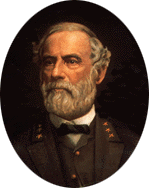
Lee in the Mountains

A poem in memory of a Great American.


Walking into the shadows, walking alone
Where the sun falls through the ruined boughs of locust
Up to the president's office. . . . Hearing the voices
Whisper, Hush, it is General Lee! And strangely
Hearing my own voice say, Good morning, boys.
(Don't get up. You are early. It is long
Before the bell. You will have long to wait
On these cold steps. . . .)


The young have time to wait
But soldiers' faces under their tossing flags
Lift no more by any road or field,
And I am spent with old wars and new sorrow.
Walking the rocky path, where steps decay
And the paint cracks and grass eats on the stone.
It is not General Lee, young men. . .
It is Robert Lee in a dark civilian suit who walks,
An outlaw fumbling for the latch,
a voice Commanding in a dream where no flag flies.


My father's house is taken and his hearth
Left to the candle-drippings where the ashes
Whirl at a chimney-breath on the cold stone.
I can hardly remember my father's look, 
I cannot Answer his voice as he calls farewell in the misty Mounting where riders gather at gates.
He was old then--I was a child--his hand
Held out for mine, some daybreak snatched away,
And he rode out, a broken man. Now let
His lone grave keep, surer than cypress roots,
The vow I made beside him. God too late
Unseals to certain eyes the drift
Of time and the hopes of men and a sacred cause.
The fortune of the Lees goes with the land
Whose sons will keep it still. My mother
Told me much. She sat among the candles,
Fingering the Memoirs, now so long unread.
And as my pen moves on across the page
Her voice comes back, a murmuring distillation
Of old Virginia times now faint and gone,
The hurt of all that was and cannot be.
Why did my father write? I know he saw
History clutched as a wraith out of blowing mist
Where tongues are loud, and a glut of little souls
Laps at the too much blood and the burning house.
He would have his say, but I shall not have mine.
What I do is only a son's devoir
To a lost father. Let him only speak.
The rest must pass to men who never knew
(But on a written page) the strike of armies,
And never heard the long Confederate cry
Charge through the muzzling smoke or saw the bright Eyes of the beardless boys go up to death.
It is Robert Lee who writes with his father's hand--
The rest must go unsaid and the lips be locked.
If all were told, as it cannot be told--
If all the dread opinion of the heart
Now could speak, now in the shame and torment
Lashing the bound and trampled States--
If a word were said, as it cannot be said--
I see clear waters run in Virginia's Valley
And in the house the weeping of young women
Rises no more. The waves of grain begin.
The Shenandoah is golden with a new grain.
The Blue Ridge, crowned with a haze of light,
Thunders no more. The horse is at plough. 

The rifle Returns to the chimney crotch and the hunter's hand.
And nothing else than this? Was it for this
That on an April day we stacked our arms
Obedient to a soldier's trust? To lie
Ground by heels of little men,
Forever maimed, defeated, lost, impugned?
And was I then betrayed? Did I betray?
If it were said, as it still might be said--
If it were said, and a word should run like fire,
Like living fire into the roots of grass,
The sunken flag would kindle on wild hills,
The brooding hearts would waken, and the dream
Stir like a crippled phantom under the pines,
And this torn earth would quicken into shouting Beneath the feet of the ragged bands--
 

The pen---Turns to the waiting page, the sword
Bows to the rust that cankers and the silence.
Among these boys whose eyes lift up to mine
Within gray walls where droning wasps repeat
A hollow reveille, I still must face,
Day after day, the courier with his summons
Once more to surrender, now to surrender all.
Without arms or men I stand, but with knowledge only
I face what long I saw, before others knew,
When Pickett's men streamed back, and I heard the tangled
Cry of the Wilderness wounded, bloody with doom.
The mountains, once I said, in the little room
At Richmond, by the huddled fire, but still
The President shook his head. The mountains wait,
I said, in the long beat and rattle of siege
At cratered Petersbyrg. Too late
We sought the mountains and those people came.
And Lee is in the mountains now, beyond Appomatox,
Listening long for voices that will never speak
Again; hearing the hoofbeats that come and go and fade
Without a stop, without a brown hand lifting
The tent-flap, or a bugle call at dawn,
Or ever on the long white road the flag
Of Jackson's quick brigades. I am alone,
Trapped, consenting, taken at last in mountains.
It is not the bugle now, or the long roll beating.
The simple stroke of a chapel bell forbids
The hurtling dream, recalls the lonely mind.
Young men, the God of your fathers is a just
And merciful God Who in this blood once shed
On your green altars measures out all days,
And measures out the grace
Whereby alone we live;
And in His might He waits,
Brooding within the certitude of time,
To bring this lost forsaken valor
And the fierce faith undying
And the love quenchless
To flower among the hills to which we cleave,
To fruit upon the mountains whither we flee,
Never forsaking, never denying
His children and His childrens children forever
Unto all generations of the faithful heart.

Saturday, January 14, 2006

STUCK ON STUPID.............

I have been thinking a lot lately about many things... the state of my life, the state of our economy, the state of our morality, the state our religioniousness, the state of our government's influence in our daily life, the state of why an intelligent society allows itself to be duped by politicians and led around by their collective noses to agree to things that only a few years ago they (the politicians) would have screamed in rebellion against. Libertarians are confused by a conservative government that in all aspects is more liberal spending than the most Liberal in the past 70 years. Conservatives say they hold values, yet they erode more connections and agreements than they conserve. The only thing they have learned to conserve is their own power. Conservation...is nothing to a conservative! I refuse to listen to talk radio and the talking heads that spout the talking points straight out of the DC think tanks. Which are the conservative version of intellectual groups. For a group that is so confident, they have a lot of opinion makers, that do not agree with each other. To be a group, they are very splintered.
I also find it amusing that the intellectual conservatives have used a "dumbing down" philosophy to connect with the mainstream of society, since the mainstream has been proven to be skeptical of intellectuals. At least that's what the conservative talking heads have said for years now...
It is also funny how Fox News more resembles the National Enquirer than it does a real new outlet. Tabloid Entertainment, maybe that is why the common people have shifted to watching Fox instead of traditional new. Watch a few moments of Fox News and you will notice that by the "terror alert status" at the bottom of the screen and the constant reminder of "bad" news on the ticker at the bottom of the screen also. They also tend to focus on stories that illist an emmotional response, rather than a rational one. Always telling of the evils and complaining about everyone else that only does nothing positive, while repeating more, if not more of the same.

"Evil is unspectacular and always human, and shares our bed and eats at our own table." ~ W. H. Auden

We must remember in our human frailty to forgive our enemies and our friends just as Jesus taught us to do. It is a difficult task to forgive those who have wronged you even when we know we are right, but if we allow pride to get in the way we are at fault just as much as those that wronged us in the beginning.

"It is easier to forgive an enemy than to forgive a friend." ~ John Dryden

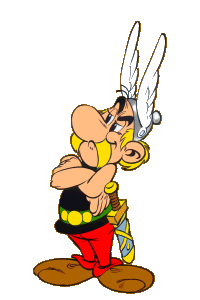
On a much lighter note I rediscovered an old friend ASTERIX!!

Friday, January 13, 2006

How will we know?


"In many ways, the evangelical churches are much more reflecting our modern culture than they are really being shaped by the Gospel." ~ Os Guinness

Years from now how will we know what the effects of the past has made on the future? Will we be able to predict the outcomes of elections and conflicts by prior actions of lunatic fringe of the present? Today's Pat and Jerry may be tomorrow's Moshe and Jack. Why are people obsessed in portraying an all-knowing point of view? We are obliged to allow God to work things out on his own. Let's face it, He's been doing it a very long time. Who are we to question Him.
I received an email from a college friend of mine who regards himself as the expert in residence on all things political regarding conservative, libertarian, religious and anti-governmental in these days. Yet, remembering him and his deep beliefs he fits these values only when they serve his needs. He is strongly anti-abortion, however, he is probably the one person that I have known that would have suggested a young female acquaintance should visit a clinic that specialized in family planning.
He is conservative, only in that he believes in a strong military, that does not or did not include him. He is so religious that the last few times he was in a church were for his brother's funeral and his wedding over twenty years ago. Libertarian, in that he thinks the government should keep their nose out of his business, especially the drug use and alcohol abuse. That leads to his anti-governmental feelings and support of Grover Norquist...well, that the pot calling the kettle, crooked. Besides the fact that he left the US to get away from child support.
He always wants to abstain from political discussions when he is presented with facts and information. He never wants to discuss the overall opinion of the entire country. He doesn't like facts, only opinion, his. But he never fails to restart by sending out a probing, proding, ugly email to those progressive among us that count him as a friend.

"Too much Christian faith is in a flight from reason and ends up being very simplistic and irrational but my position is for Christian that thinks in believing and believes in thinking." ~ Os Guinness

The Christian writer Dr. Os Guiness has addressed this issue about whether or not we will know, or whether or not it matter with the following quote:

"The other problem with an over fascination of the end times is that it cuts the nerve of Christian engagement with society. So the Church is no longer salt and light." ~ Os Guiness

Thursday, January 12, 2006

Random Thought


IF TODAY IS THE FIRST
DAY OF THE REST OF MY
LIFE, THEN WHEN WAS LAST
DAY OF THE REST OF MY LIFE?
What happens to a man that he becomes obsessed with his state of being? As we approach middle age and our body stops its natural regeneration processes, we feel the effects of aging
more readily each day. We cannot allow our mind to
freeze with the rest of our decaying body. Excercise it daily, hourly so that it will not lose it acuteness.
"Learning is weightless, a treasure you can always carry easily." ~ Chinese Proverb

Maybe I'm Just a Dreamer


HAVE YOU EVER ......
sat and listened to the crickets calling out to each other on a warm southern night? On these winter days I long for the nights of summer: sounds of families at the local ballpark, smells of overcooked popcorn and steamed hotdogs, additional subtle reminders of the heat of the day. A rising aroma of the sporadic summer rain that seems to fall every afternoon. Nearby the gins are working on the harvest of this season and the dusk is filled with a haze of peanut hulls and cotton lint. Pray that the sinuses don't act up in the morning.
HAVE YOU EVER ..... sat on the bank of a shallow farm pond waiting for one last fish to bite before calling it a day? Musky scents of the willows or cypress that line the bank drift into your olfactory glands and tickle the nerves unlike any other. Across the pond you may hear a splash and be tempted to move to a more procductive spot, yet the fish are feeding and soon you should reach your limit.
HAVE YOU EVER ..... sat in a deer stand or duck blind on a cold winter morning and told yourself that this was the last time you would ever do this? Then just when you had endured all the cold you thought humanly possibly, your senses became aware of God's world and all of it's glory in the grayness of the morning light. As the sun slowly rose and warmed your cold hands and feet, you thanked Him for another day.
HAVE YOU EVER ..... went to school and been called a n*****r lover, because your family had a maid? Or have you got into a fight with someone you thought was your best friend because he turned out to be a racist? Today it seems apalling that so many conservatives will not say in public what they say in private, because they don't want to appear as being racist or intolerant. But they are both in private. I had forgotten what it was like in parts of our great country. Some places I have lived have been very blind to a persons color, race, religion or nationality. Funny thing is some of those places are in the deep, deep South.
But what makes this so much more disturbing is that these conservative are hiding behind the church to spread the bigotry of race, color, religion and nationalism.
HAVE YOU EVER .....
sat on your front porch with a loaded shotgun as a twelve year old waiting for the KKK to drive by and firebomb your house? I have. We were tipped off by someone in the klan that knew my Dad, who my father had helped in the past. So as an impressionable twelve year old I sat waiting with my Dad on my front porch for the klan to attack our house. So you may ask why us? No, we are not black, hispanic, catholic, muslim, jewish or any other group that the KKK singled out to hate in the 1950's and 1960's. My family came to America in the 1600's, fought in the Revolutionary War, owned slaves, freed slaves, fought in the Civil War, fought in the Spanish American War, fought in World War I, moved west with the migration of America, moved back east, fought in World War II, and now has fought in the Middle East.
They picked us because we did not support them or their agenda. What is funny now is that I was friends with the sons and grandsons of many of the officers of the mystery organization. I've often wondered if my friends knew that their dads and grandads had threatened to burn down my house and kill my family, but time doesn't heel all wounds. One son and one grandson are a judge and a lawyer in my hometown...I wonder if they are members?
The League of the South has a motto that they think applies to the Southron Cause, yet I think it applies more here:
Deo Vindice (God will vindicate us.)

HAVE YOU EVER .....
taken the time to just dream of a better tomorrow.
"The problem with being sure that God is on your side is that you can't change your mind, because God sure isn't going to change His." ~ Roger Ebert, film-critic (1942- )

"Bureaucracy defends the status quo long past the time when the quo has lost its status." ~ Dr. Laurence J. Peter
Tomorrow is another day....................

Wednesday, January 11, 2006

From Southern Exposure 1974


OUR PROMISED LAND
"Speed now the day when the plains and the hills and all the wealth thereof shall be the people’s own and free men shall not live as tenants of men on the earth…" ~ Ceremony of the Land, Southern Tenant Farmer’s Union (1937)

I've been re-reading some old periodicals we purchased at a thrift store in Blacksburg, VA a few years ago and came across this great quote.....

"Our long national nightmare is over..." ~ President Gerald R. Ford

and it was followed by this prophetic comment in the ad it was included in:
"NO WAY!" ~ The Progressive
...It goes on to say.
No way is the nightmare over. Watergate was only a small part of it; rising unemployment, skyrocketing prices, shortages of housing, gasoline, home heating fuels, grain, aluminum.... For millions, the American Dream is turning into an American nightmare.

And then...
"Our society cannot continue indefintely to decay. It seems virtually certain that it the Left does not begin to give voice and direction to the growing anti-corporate anger, then a right-wing politician like Wallace will, through demagogic appeals to fear and uncertainty. It is a crucial time in which to work and build." ~ Harry Boyte from Prospectus for a New Party

So even thirty one years ago it was apparent that demagogic right-wing politicians would use fear to convince the masses of a need to fall into lock step with them. Our need for security is a basic need, yet one that cannot out-weigh the desire for freedom.

With the current K street mess in DC, the adjusted employment figures, continued rising prices, the upcoming fall of the housing market, OIL PRICES (that they could not have dreamed of in 1974), food shortages due to drought, and production shortages due to corporate America not spending the money to upgrade facilities....umm...sounds vaguely familiar.

"We will bankrupt ourselves in the vain search for absolute security." ~ Dwight David Eisenhower, U.S. general and 34th president (1890-1969)

Tuesday, January 10, 2006

Pilgrim's Road


The Bridge Builder
by Will Allen Dromgoole

An old man, going a lone highway,
Came at the evening, cold and gray,
To a chasm, vast and deep and wide
Through which was flowing a sullen tide.

The old man crossed in the twilight dim;
The sullen stream had no fears for him;
But he turned when safe on the other side
And built a bridge to span the tide.

"Old Man," said a fellow pilgrim near,
"You are wasting strength with building here;
Your journey will end with the ending day;
You never again must pass this way;
You have crossed the chasm, deep and wide --
Why build you the bridge at the eventide?"

The builder lifted his old gray head;
"Good friend, in the path I have come," he said,
"There followeth after me today
A youth whose feet must pass this way.
This chasm that has been naught to me
To that fair-haired youth may a pitfall be.
He, too, must cross in the twilight dim;
Good friend, I am building the bridge for him!"

For all the Men since 1856

Tuesday's Tidbit


A view of the Plains

Glimpses of tomorrow give us strength to endure the misfortunes of today. While realization of our mistakes fortifies our caracter with mortar that will not crumble as time ages our foundation.

Foundations are built brick by brick, our character likewise is established by using our mistakes and experiences to develop our strengths.

It is hard for an outsider to understand what it means to be an Auburn man or woman, they cannot understand why a town allows several thousand people to throw toilet paper over power lines and into trees, paint everything orange and blue, and yell at the top of their lungs for hours on end.

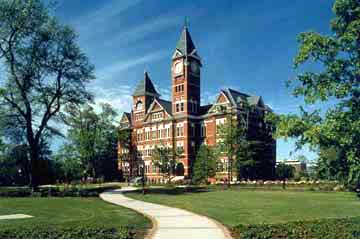
A chill runs up along your spine as you exit I-85 and it builds with anticipation as you pass familiar landmarks. The War Eagle Supper Club, the remains of the old cinderblock building that used to be the closest beer store to campus (The Tiger), The Casino, the building that housed WAUD. Then you realize as you head down that small hill into town, that up ahead, past the new buildings, is the familiar clocktower of Samford Hall, and you're home. AUBURN
Unknown

Friday, January 06, 2006

Working through a tough day....

Working through a tough day...
Some days we need a small amount of time just to sit and think about the upcoming hours, minutes, or seconds. Just to clear our mind and allow the fog to roll out and make the vision perfectly clear. Today's world is so compliacated that we don't need any distractions to inhibit us from the tasks at hand.
Our mind must be truly focused on what we need to accomplish and only that need, or else, we will cause ourself to become the distraction.
Do not neglect even the smallest things, for there is glory and wonder even in these small things. The minute details are where God hides the most magnificient phenomenons He has created. Have you ever examined the structure of the spider's web that spans a gap between two stick-ups as you round the corner of an abandoned barn? Or noticed how a bird builds its nest between the branches of a undersized shrub next to the house? Followed the trail of a snail or slug across the sandy soil? The patterns of the natural world are there for a purpose.
"The Lord made small things as well as big ones, and everything man looks at closely is full of wonder." ~ Jacob Grimm
We must all pursue a different path in life, some easy, some hard, some with great difficulty, yet with each it is how we ultimately live that life that matters most.
"The manner in which one endures what must be endured is more important than the thing that must be endured." ~ Dean Acheson
Our conscience only allows us to do what our nature is prepared to do. If we are taught properly, we will respond correctly. Only if there is a propensity to engage in illegal and immoral activity will one do so. Keep your true moral compass high and straight.
"Justice, justice, shall you pursue. ~ Deuteronomy 16:20" ALWAYS JUSTICE!

Wednesday, December 14, 2005

Unfamiliar with Bush's Bible


Unfamiliar with Bush's Bible

by Warren Hynson
Technician (North Carolina State University) 11-17-2005

It was Gandhi who once said, "He who says that religion and politics don't mix understands neither one." Our "Leader of the Free World," President George W. Bush, is a deeply committed Christian. I am not writing about his personal relationship with Christ -- that is only between him and God. He has discussed his faith publicly, many times, and has more often than not included passages from Scripture and hymns in his numerous speeches and addresses. Bush has been labeled by many as the most openly religious president in many generations, if not ever.

As I said earlier, I am not questioning our president's faith, only the role it seems to play in our nation's foreign and domestic policy. The book of James says, "faith without deeds is useless," and also that "a person is justified by what he does and not by faith alone." So I am only left to wonder where in the Word of God does our faithful president find evidence that supports some of our nation's public policies? Certainly not in any Bible that I have ever read. In fact, not only would Scripture not justify some of our government's plans, it would actually call us to correct them. Just last week in the House of Representatives, a bill was proposed to modify its budget. This included cuts of $9.5 billion in Medicare, $8 billion in foster care and aid to the disabled and finally $844 million in the Food Stamps Program. Thus an estimated 300,000 people will no longer be receiving any help to put food on the table and 40,000 underprivileged children will be cut from reduced-price school lunches.

I am confident there is nothing in the Bible that justifies such policies. Especially when Jesus says, "As you've done to the least of these, you have done to me," and that is not to mention the other 2,000 verses referencing the poor in the Bible. Bush has admitted he doesn't know much about the poor. He has been quoted as saying, "I don't understand poor people. I don't live and never have lived around poor people. I don't know [how] poor people think. Frankly, I'm a white Republican guy who just doesn't get it. But I'd like to. How do I get it? How do I understand?" Well, if you really want to know, get to know the poor, because to Jesus, they are the ones who are blessed and to whom the Kingdom of God belongs.

On Ellis Island, on the first anniversary of Sept. 11, Bush talked about how America stands as a beacon of light to the world, and the light shines in the darkness, and the darkness has not overcome it. That is found in the Gospel of John. But the light mentioned there is quite different from the light that the president was speaking of. It is the word of God and the light of Christ, not the flare of American freedom. So now Scripture is being altered and choreographed into what will best accommodate Bush's plans and policies for the people of America. Jim Wallis, founder and editor of Sojourners, says, "It confuses American civil religion and biblical faith. It confuses God's purposes with the best interests for American foreign policy." As a Christian, I abhor the idea of God's word being used as a safety blanket to assure the people of America that God would want us to do this or that.

Walter Slayer, a reporter from The Dallas Morning News, has closely followed Bush's political career and talked privately with him about his faith. He notes that Bush has privately admitted that clearly, he is a person chosen by God at this particular point in time to represent the interests, not only of a nation, but the guidance of God at a troubled time in the country. If Bush wishes to think he has been divinely called to lead this nation, fine; he can think whatever he wants. But I believe God did not call him to take advantage of the poor or put him in the pulpit of our National Cathedral to call the nation to arms with his war propaganda that claimed our "divine mission to rid the world of evil." Without the president's reminder, I almost forgot God was American. Not only does that constitute dangerous policy but more importantly dangerous theology -- something a man of sincere faith should be greatly concerned with.

© 2005 NCSU SMA

Monday, July 04, 2005

Bill Moyers' in June

Published on Monday, June 6, 2005 by CommonDreams.org
'Writing the History of the Revolution is Now Up to You' by Bill Moyers This is the prepared text of the speech Bill Moyers gave at Take Back America: The Conference for America's Future, sponsored by the Institute for America's Future, in Washington on Friday, June 3, 2005:
It's good to be with you again. Your passion for democracy is inspiring and your enthusiasm contagious. I can't imagine a more exuberant gathering today except possibly at the K Street branch of the Masters of the Universe where they are celebrating their coup at the Securities and Exchange Commission I wish that I could have attended all your sessions, listened to all the speakers, and heard all the points of view that have been raised here. But thanks to C-Span I was able to catch enough of your proceedings to realize you covered so many subjects and touched on so many ideas that you've left me little to say. That's okay, because as Bob Borosage reminded us back in January, what matters most isn't what is said in Washington but what you do on the ground across the country to build an independent infrastructure, generate ideas, drive local campaigns, persuade the skeptic, organize your neighbors, and carry on the movement at the grass roots for social and economic justice. Before you go home, however, Bob has asked me to talk about what's at stake in what you are doing. Given all that has already been said, I will take my cue from the late humorist Robert Benchley who arrived for his final exam in international law at Harvard to find that the test consisted of this one instruction: "Discuss the arbitration of the international fisheries problem in respect to hatcheries protocol and dragnet and procedure as it affects (a) the point of view of the United States and (b) the point of view of Great Britain." Benchley was desperate but he was also honest, and he wrote: "I know nothing about the point of view of Great Britain in the arbitration of the international fisheries problem, and nothing about the point of view of the United States. I shall therefore discuss the question from the point of view of the fish." That's what I have done in much of my work in journalism. Thirty-five years ago almost to the day I set out on a three-month trip of over 10, 000 miles to write a book called "Listening to America." I completed the book but I've never finished the trip; never was able to come off the road; never could stop listening. My worldview has been a work in progress, molded largely by the stories I've heard from the people I've met. I want to tell you this morning about some of those people. They tell us what's at stake. I begin with two families in Milwaukee. The breadwinners in both households lost their jobs in that great wave of downsizing in 1991 as corporations began moving jobs out of the city and out of the country. In a series of documentaries over the next decade my colleagues and I chronicled their efforts to cope with the wrenching changes in their lives and find a place for themselves in the new global economy. I grew up with people like them. They're the kind my mother called "the salt of the earth" (takes one to know one!) They love their children, care about their neighborhoods, go to church every Sunday, and work hard all week. But like millions of Americans, these two families in Milwaukee were playing by the rules and still losing. By the end of the decade they were running harder but slipping behind, and the gap between them and prosperous America had reached Grand Canyon proportions. I want to show you a very brief excerpt from that first documentary. It aired on PBS in January 1992 with the title "Minimum Wages: The New Economy." You'll see the father of one family as he looks for work after losing his machinist's job at the big manufacturer, Briggs and Stratton. You'll meet his wife in their kitchen as they make a desperate call to the bank that is threatening to foreclose on their home after failing to meet their mortgage payments. During our filming the fathers in both families became seriously ill. One was hospitalized for two months, leaving the family $30,000 in debt. You'll hear the second family talk about what it's like when both parents lose their jobs, depriving them of health insurance and putting their children's education up for grabs. Take a look. [VIDEO] Seeing those people again I thought of the interviews that the Campaign for America's Future conducted around the country on the eve of your conference. A woman in Columbus, Ohio, told one interviewer something that I've heard in different ways in my own reporting over the past few years. She said: "Everyday life pulls families apart." It takes a moment for the implications of that to hit home. Think about it: Our country, the richest and most powerful nation in the history of the race -- a place where "everyday life pulls families apart." What turns these personal traumas into a political travesty is that the people we're talking about are deeply patriotic. They love America. But they no longer believe they matter to the people who run the country. When our film opens, they are watching the inauguration of Bill Clinton on television in 1992. By the end of the decade, when our final film in the series aired, they were paying little attention to politics; they simply didn't think their concerns would ever be addressed by our governing elites. They are not cynical - their religious faith leaves them little capacity for cynicism -- but they know the system is rigged against them. As it is. You know the story: For years now a relatively small fraction of American households have been garnering an extreme concentration of wealth and income as large economic and financial institutions obtained unprecedented levels of power over daily life. In 1960 the gap in terms of wealth between the top 20% and the bottom 20% was 30-fold. Four decades later it is more than 75 fold (See Joshua Holland, Alternet, posted 4/25/05.). Such concentrations of wealth would be far less of an issue if everyone were benefiting proportionally. But that's not the case. Statistics tell the story. Yes, I know -- statistics can cause the eyes to glaze over, but as one of my mentors once reminded me, "It is the mark of a truly educated man [or woman] to be deeply moved by statistics." Let's see if these statistics move you. While we've witnessed several periods of immense growth in recent decades, the average real income of the bottom 90 percent of American taxpayers - that's a heap of people - fell by 7 percent between 1973 and 2000 (ibid.) During 2004 and the first couple of months this year, wages failed to keep pace with inflation for the first time since the 1990 recession. They were up somewhat in April, but it still means that "working Americans effectively took an across-the-board pay cut at a time when the economy grew by a healthy four percent and corporate profits hit record highs as companies got more productivity out of workers while keeping pay raises down." (ibid) Believe it or not, the United States now ranks the highest among the highly developed countries in each of the seven measures of inequality tracked by the index. While we enjoy the second highest GDP in the world (excluding tiny Luxembourg), we rank dead last among the 20 most developed countries in fighting poverty and we're off the chart in terms of the number of Americans living on half the median income or less (ibid) And the outlook is for more of the same. On the eve of George W. Bush's second inauguration The Economist - not exactly a Marxist rag - produced a sobering analysis of what is happening to the old notion that any American can get to the top. With income inequality not seen since the first Gilded Age (and this is The Economist editors speaking, not me) - with "an education system increasingly stratified with fewer resources than those of their richer contemporaries" and great universities "increasingly reinforcing rather than reducing these educational inequalities" - with corporate employees finding it "harder…to start at the bottom and rise up the company hierarchy by dint of hard work and self-improvement" - "with the yawning gap between incomes at the top and bottom" - the editors of The Economist - all friends of business and advocates of capitalism and free markets -- concluded that "The United States risks calcifying into a European-style class-based society." Let me run that by you again: "The United States risks calcifying into a European-style class-based society." Or worse. The Wall Street Journal is no Marxist sheet, either, although its editorial page can be just as rigid and dogmatic as old Stalinists. The Journal's reporters, however, are among the best in the country. They're devoted to getting as close as possible to the verifiable truth and describing what they find with the varnish off. Two weeks ago a front-page leader in the Journal concluded that "As the gap between rich and poor has widened since 1970, the odds that a child born in poverty will climb to wealth - or that a rich child will fall into middle class - remain stuck….Despite the widespread belief that the U.S. remains a more mobile society than Europe, economists and sociologists say that in recent decades the typical child starting out in poverty in continental Europe (or in Canada) has had a better chance at prosperity." (Wall Street Journal, page one, May 13, 2005.) That knocks the American Dream flat on its back. But it should put fire in our bellies. Because what's at stake is what it means to be an American. A few weeks ago my colleague Charlie Rose put a question to the new president of CNN, Jonathan Klein. He asked: Could there ever be a successful progressive version of Fox News Channel? Klein didn't think so. He said Fox appeals to "mostly angry white men" while liberals -- "you know, they don't get too worked up about anything." Well, here's something to get worked up about: Under a headline stretching six columns across the page, the New York Times reported last year that tuition in the city's elite private schools, kindergarten as well as high school, would hit $26,000 for the coming school year. On the same page, under a two-column headline, the Times reported on a school in nearby Mount Vernon, just across the city line, with a student body that is 97% black. It is the poorest school in the town: Nine out of ten children qualify for free lunches; one out of ten lives in a homeless shelter. During black history month this past February a sixth-grader who wanted to write a report on the poet Langston Hughes could not find a single book about Hughes in the library - not one. There is only one book in the library on Frederick Douglass. None on Rosa Parks, Josephine Baker, Leontyne Price, or other path breakers like them in the modern era. Except for a couple of Newbery Award books bought by the librarian with her own money, the books are largely from the 1950s and 1960s, when all the students were white. A child's primer on work begins with a youngster learning how to be a telegraph delivery boy. There's a 1967 book about telephones with the instruction: "When you phone you usually dial the number. But on some new phones you can push buttons." The newest encyclopedia dates from 1991, with two volumes missing. And there is no card catalogue in this library. Something worth getting mad about. How about this: Caroline Payne's face and gums are distorted because her Medicaid-financed dentures don't fit. Her appearance has caused her to be continuously turned down for jobs. Caroline Payne is one of the people in David Shipler's recent book, The Working Poor: Invisible in America. She was born poor; although she once owned her own home and earned a two-year college degree, Caroline Payne has bounced from one poverty-wage job to another all her life, equipped with the will to move up, but lacking the resources to deal with such unexpected and overlapping problems as a mentally handicapped daughter, a broken marriage, and a sudden layoff that forced her to sell her few assets, pull up roots, and move on. "In the house of the poor…" Shipler writes, "the walls are thin and fragile, and troubles seep into one another." If you believe the Declaration of Independence means what it says - that all of us are endowed by the Creator with a love of life, a longing for liberty, and a passion for happiness - and everyone includes Caroline Payne - this is something to get worked up about. Or this - courtesy of the columnist, Mark Shields. It seems workers in the American territory of the Northern Mariana Islands were being forced to labor under sweatshop conditions producing garments for Tommy Hilfiger, Calvin Klein, Gap and Liz Claiborne. The garments were then shipped tariff-free and quota-free to the American market where they were entitled to display the coveted "Made in the USA" label. When Republican Senator Frank Murkowski of Alaska heard that these people were being paid barely half the U.S. minimum hourly wage and were forced to live behind barbed wire in squalid shacks without plumbing while working 12 hours a day, often seven days a week, with none of the legal protections U.S. workers are guaranteed, he became enraged. He got the Senate to pass a bill - unanimously - that would extend the protection of our laws to the U.S. territory of the Northern Marianas. But then the notorious lobbyist Jack Abramoff moved into action with an SOS to his good friend, Tom DeLay. The records show they met at least two dozen times. DeLay traveled to the Marianas with his family and staff - on a "scholarship" provided by Abramoff's clients -- where they played golf and went snorkeling not far the sweatshops (some scholarship!) Was Tom DeLay offended by what he saw? To the contrary. He told the Washington Post that the sweatshops were "a perfect petri dish of capitalism. ABC-TV News recorded him praising Abramoff's clients by saying: "You are a shining light for what is happening to the Republican Party, and you represent everything that is good about what we are trying to do in America and leading the world in the free-market system." And Tom Delay - the rightwing radicals' revisionist incarnation of Saint Francis of Assisi -- killed the Senate bill. (Mark Shields, CNN.com. 5/28/05.) If that doesn't get your dander up, maybe this will: The minimum wage hasn't been raised since l997. After the Republicans recently defeated an effort to increase it, Rick Wilson wrote for CommonDreams.org about a single mother of two children working somewhere in his home state of West Virginia at $5.15 an hour, 40 hours a week, or $5,378 below the federal poverty level of $16,090 for a family that size. Put another way, "her earnings only reach two-thirds of the poverty level." Meanwhile, the base salary of the Members of Congress who voted down the wage increase is $162,100. That single mom would have to work about 31, 476 hours to earn what those members of Congress get in a year. And remember -- the minimum wage she earns is actually worth less than it was 40 years ago (Rick Wilson, CommonDreams.org. 5/25/05.) It wasn't supposed to be this way. America was not meant to be a country where the winner takes all. Through a system of checks and balances we were going to maintain a decent equilibrium in how democracy works so that it didn't just work for the powerful and privileged (If you don't believe me, I'll send you my copy of The Federalist Papers). The economist Jeffrey Madrick put it well: Because equitable access to public resources is the lifeblood of any democracy, Americans made primary schooling free to all. Because everyone deserves a second chance, debtors - especially the relative poor - were protected by state laws against their rich creditors. Charters to establish corporations were open to most if not all (white) comers, rather than held for elites. Government encouraged Americans to own their own piece of land and even supported squatters' rights. The old hope for equal access to opportunity became a reality for millions. Including yours truly. Ruby and Henry Moyers were knocked down and almost out when the system imploded into the Great Depression. They worked hard all their lives but never had much money - my father's last paycheck before he retired was $96 and change, after taxes. We couldn't afford books at home but the public library gave me a card when I was eight years old. I went to good public schools. My brother made it to college on the GI bill. And in my freshman year I hitchhiked to college on public highways stopping to rest in public parks. Like millions of us, I was an heir to what used to be called the commonwealth - the notion of America as a shared project. It's part of our DNA, remember: "We, the People…in order to create a more perfect union" You're never more mindful of this than at the Lincoln Memorial. Like you, I've been there many times over the years. Back in 1954, when I was a summer employee in the Senate, I took the same hike every Sunday. Starting at the Capitol I headed for the Washington Monument, briskly climbed its 898 steps, came down almost as briskly (I was only 20, remember), veered over to the Jefferson Memorial and then doubled back to the mall and down past the reflecting pool to where Lincoln gazes perpetually over this city - a city that because of him is the capital of the United States of America and not just the Northern States of America. Standing there last night, I sensed that temple of democracy where Lincoln broods to be as deeply steeped in melancholy as it was during the McCarthy reign of terror, the grief of Vietnam, or the crimes of Watergate. You stand there silently contemplating the words that gave voice to Lincoln's fierce determination to save the Union - his resolve that "government of, by, and for the people shall not perish from the earth" - and then you turn and look out, as he does, on a city where those words are daily mocked. This is no longer Lincoln's city. And those people from all walks of life making their way up the steps to pay their respects to this martyr for the Union - it's not their city, either. This is an occupied city, a company town, a wholly-owned subsidiary of the powerful and privileged who have hired an influence racket to run it. The records are so poorly kept it's impossible to know how many lobbyists there really are in this town, but the Center for Public Integrity found that their ranks include 240 former members of Congress and heads of federal agencies and over 2000 senior officials who passed through the revolving door of government at warp speed. Lobbyists now spend $3 billion a year buying influence and access for their clients and, according to the New York Times, over the last six years spent more than twice the amount spent by candidates for federal office. Once again this is a divided city. Not between North and South as in Lincoln's time, but between those who pay to play - those who can buy the government they want -- and those who can't even afford even a seat in the bleachers. So it is that huge financial institutions like MBNA - the credit card giant that is the biggest contributor to the President's two campaigns for the White House - prevail in getting Congress and George W. Bush to curtail personal bankruptcies, making it harder for those families in Milwaukee to get a fresh start and a second chance. So it is that Wal-mart, with the third largest corporate political action committee in the country, and pharmaceutical giants with more lobbyists in town than there are Members of Congress, join with gun manufacturers and asbestos makers and the White House to restrict the right of aggrieved citizens to take corporations to court for malfeasance. So it is that as ExxonMobil accumulates more than $1 billion a month from escalating oil prices -- more than $1 billion a month even after allocating for dividends, share repurchases, and capital spending - the oil and gas industry wrings huge tax breaks from a public already squeezed hard by high prices at the gas pumps. And so it is that on the Sunday before President Bush's second inaugural, Nick Confessore, writing in the New York Times Magazine, describes how the president's first round of tax cuts has brought the United States tax code closer to a system under which income from savings and investments would not be taxed at all and revenues for public services would be raised exclusively from taxes on working men and women. One of the most fervent right-wing class warriors in Washington is quoted as predicting: "No capital gains tax, no dividends tax. No estate tax, no tax on interest." It will be one of President Bush's enduring legacies to have replaced estate taxes on the wealthy with a sweat tax on their grave diggers. Let me read you something: When political interests shower Washington with millions in campaign contributions, they often get what they want. But it's ordinary citizens and firms that pay the price and most of them never see it coming. This is what happens if you don't contribute to their campaigns or spend generously on lobbying. You pick up a disproportionate share of America's tax bill. You pay higher prices for a broad range of products from peanuts to prescriptions. You pay taxes that others in a similar situation have been excused from paying. You're compelled to abide by laws while others are granted immunity from them. You must pay debts that you incur while others do not. You're barred from writing off your tax returns some of the money spent on necessities while others deduct the cost of their entertainment. You must run your business by one set of rules, while the government creates another set for your competitors. In contrast the fortunate few who contribute to the right politicians and hire the right lobbyists enjoy all the benefits of their special status. Make a bad business deal; the government bails them out. If they want to hire workers at below market wages, the government provides the means to do so. If they want more time to pay their debts, the government gives them an extension. If they want immunity from certain laws, the government gives it. If they want to ignore rules their competition must comply with, the government gives its approval. If they want to kill legislation that is intended for the public, it gets killed. Once again I'm not quoting Marx or Lenin or even The Nation, the American Prospect, the Washington Monthly, In These Times, The Progressive, or Mother Jones. I'm quoting from…..Time. From the heart of the Time-Warner empire comes the judgment that America now has "government for the few at the expense of the many." You read this, and then you read the report by the American Political Science Association which finds that "increasing inequalities threaten the American ideal of equal citizenship and that progress toward real democracy may have stalled in this country and even reversed." You also read - in that same report - that a quarter of all whites in this country have no financial assets. Then you read on and learn that the median white household has 62% more income and twelve times as much wealth as the median black household and that 61% of African-Americans in this country and half of all Latinos have no financial assets at all. Then you open Jared Diamond's new book, Collapse: How Societies Choose to Succeed or Fail to find the Pulitzer Prize-winning scholar's description of an America where rich elites cocoon themselves "in gated communities, guarded by private security guards, and filled with people who drink bottled water, depend on private pensions, and send their children to private schools." Gradually, they lose the motivation "to support the police force, the municipal water supply, Social Security, and public schools." Any society where the elite insulate themselves from the consequences of their action, Diamond warns, contains a built-in blueprint for failure. You read all this and realize you have been seeing it with your own eyes as a reporter in the field. You're seeing the mugging of the American Dream right before your eyes. Go with me for a moment to a small town in Pennsylvania. Two years ago, for my weekly PBS series Now with Bill Moyers, one of our teams spent time there listening to regular people talk about what's happening in their lives. I want to share with you an excerpt so that you can eavesdrop on the hidden conversation of America that the ruling powers in Washington wants to stay hidden, as I'll explain in a moment. Let me tell you something about these people ("the point of view of the fish," remember?) They don't ask to get rich. They want a job that pays a living wage. They want social security to be there in their old age, for their own sake and so their kids won't be burdened with their care. They want a simple, comprehensive health care system. They want their livelihoods and the fate of their communities to be taken into account as the elites in government and corporations measure profits, economic growth and the GDP. And they would like to see the political system cleaned up, so the playing field is more level and their voices not wholly drowned out by the deep-pocket predators from the Business Roundtable. These are not radical views. These are not even "liberal" views. They are just plain American values. Any reporter who spends any time in the field can see that. You just have to get out of the Washington and New York studios, throw away the talking points sent you by the Republican National Committee, stop yakking and start listening, leave the winners to their champagne and buy the losers a beer, and you'll discover that the actual experience of regular people is the missing link in a nation wired for everything but the truth. And let me tell you: These plain American values - the truth from an America that is barely holding on - scare the hell out of the powers that be. Case in point: When that broadcast aired in November of '03, Kenneth Tomlinson was watching. As most of you know by now, Mr. Tomlinson is chairman of the Corporation for Public Broadcasting, an ally of Karl Rove, and the rightwing monopoly's point man to keep tabs on public broadcasting. You've heard no doubt that he and I have been, shall we say, somewhat at odds of late. I didn't know exactly what started the trouble until just a few days ago, when the Washington Post carried a story reporting that when Mr. Tomlinson watched that documentary from Tamaqua, Pennsylvania, it was too much for him. Reaching into the well-worn book of mindless rightwing clichés, he called it "liberal advocacy journalism" and decided right then and there "to bring some 'balance' to the public TV and radio airwaves." So what did he do? Well, apparently the saintly Tom DeLay was too busy snorkeling with lobbyists to take on his own show informing the folks in Tamaqua, Pennsylvania, that they are the "Petri dish of capitalism." But Mr. Tomlinson found kindred spirits at the rightwing editorial board of the Wall Street Journal where the "animal spirits of business" are routinely celebrated with nary a negative note about the casualties of their voracious appetites. Now you can get on public television every week, in The Wall Street Editorial Report, an alternative view of reality to life as it is lived in Tamaqua, Pennsylvania and communities like it all across this country. Here's the point: The last thing ideologues want is reporting about the facts on the ground. Facts on the ground subvert the party line. That's why if you live where rightwing talk radio and media monopolies dominate the public discourse, you are told a hundred different ways every day why unregulated markets work better than democracy. It's a lie, but it works, because you are never told the other side of the story. But here, on PBS one Friday evening, was the other side of the story. Here were ordinary people who are in pain for reasons not of their own making. And it was more than a rightwing apparatchik could take. Because too much of the truth might set those people free. Might take them to the voting booths - or even to the streets - to declare: We're mad as hell and we're not going to take it anymore!" This is a good place to pause and call on that old journalistic warhorse, Hal Crowther, who was at Time and Newsweek and the Buffalo News before going his own way with an independent column. Just this week he writes that: "The first thing every reporter was taught, back when reporters were taught things, is that the best way to find the truth is to follow the money….If the media still hunted with live ammunition, Enron, Halliburton and the energy industry's pornographic profits since 9/11 would be enough to force this oil-soaked, sheik-beholden government to resign. In disgrace-remember disgrace?" And he goes on: "Worse still than handouts to the wealthy is the reprehensible new legislation that blocks working Americans from climbing the hill where the money flows - laws like boulders rolled downhill to crush the scrambling underclass, the millions of Americans unable to pay their bills. Think about what it means to limit personal bankruptcies, inhibit class action suits against toxic employers, protect chemical polluters (usually oil companies) from liability lawsuits and cap settlements in personal injury cases. It means trying to eliminate what little protection ordinary citizens retain against corporate leviathans that cheat, exploit, injure and poison them, trap them in hopeless jobs, renege on their healthcare and default on their pensions. It means striping leverage from the people who have no leverage to spare." Hal Crowther is one of those journalists who goes hunting with live ammunition. But if Kenneth Tomlinson and Karl Rove have their way, public broadcasting journalists will be firing blanks. What's important in this story is not only that journalism still matters - that reporting from the ground up can strike a nerve in the heart of the imperium. What's important is that you see what as citizens you are up against. These guys play for keep. They mean to control the story. And if they can they will silence or discredit anyone who dissents from the official view of reality. A profound transformation is occurring in America and those responsible for it don't want you to connect the dots. We are experiencing what has been described as a "fanatical drive to dismantle the political institutions, the legal and statutory canons, and the intellectual and cultural frameworks that have shaped public responsibility for social harms arising from the excesses of private power." From public land to water and other natural resources, from media with their broadcast and digital spectrums to scientific discoveries and medical breakthroughs, a broad range of America's public resources is being shifted to the control of elites and the benefit of the privileged. It all seems so clear now that we wonder how we could have ignored the warning signs at the time. Back in the early 1970s President Nixon's Attorney General, John Mitchell, predicted that "this country is going to go so far to the right that you won't recognize it." A wealthy right-winger of the time, William Simon, President Nixon's Secretary of the Treasury, wrote a polemic declaring that "funds generated by business…must rush by the multimillions" to conservative causes. Said Business Week, bluntly: "Some people will obviously have to do with less…It will be a bitter pill for many Americans to swallow the idea of doing with less so that big business can have more." We've seen the strategy play out for years now: to cut workforces and wages, scour the globe in search of cheap labor, trash the social contract and the safety net meant to protect people from hardships beyond their control, make it hard for ordinary citizens to gain redress for the malfeasance and malpractice of corporations, and diminish the ability of government to check and balance "the animal spirits" of economic warfare where the winner takes all. Streams of money flowed into think tanks to shape the agenda, media to promote it, and a political machine to achieve it. What has happened to working Americans is not the result of Adam Smith's benign and invisible hand but the direct consequence of corporate money, ideological propaganda, a partisan political religion, and a string of political decisions favoring the interests of wealthy elites who bought the political system right out from under us. It's an old story in America. We shouldn't be surprised by it any more. Hold up a mirror to this moment and you will see reflected back to you the first Gilded Age in the last part of the 19th century. Then, as now, the great captains of industry and finance could say, with Frederick Townsend Martin, "We are rich. We own America. We got it, God knows how, but we intend to keep it." They were deadly serious. Go for the evidence to such magisterial studies of American history as Growth of the American Republic (Morison, Commager, and Leuchtenberg), and you'll read how they did it: They gained control of newspapers and magazines. They subsidized candidates. They bought legislation and even judicial decisions. To justify their greed and power they drew on history, law, economics, and religion to concoct a philosophy that would come to be known as Social Darwinism - "backed up by the quasi-religious principle that the acquisition of wealth was a mark of divine favor." One of their favorite apologists, Professor William Graham Sumner of Yale, said: "If we do not like the survival of the fittest, we have only one possible alternative, and that is the survival of the unfittest. The former is the law of civilization; the latter is the law of anti-civilization. I'm not making this up. It's right there in the record. The historians tell us that a boundless continent lay open and ready for their exploitation and "all the bounties of nature were allowed to fall into the hands of strong men and powerful corporations." Clever lawyers came up with new devices for the legal aggrandizement of private fortunes (shades of today's Federalist Society!) No labor laws or workingmen's compensation nets interfered with their profits (shades of DeLay's "Petri dish of capitalism! ") No public opinion penetrated the walls of their conceit (shades of "The Great Republican Noise Machine.") They're back, my friends. They're back in full force and their goal is to take America back - to their private Garden of Eden in that first Gilded Age when "the strong take what they wanted and the weak suffer what they must." Look no further than today's news: William Donaldson, who made a decent stab at enforcing post-Enron reform on Wall Street, is out as Chairman of the Securities and Exchange Commission; according to USA Today, the President's big donors - the captains of finance - cashed in their IOUs and came away from the White House with his head on a platter. In his place: A rightwing congressman who takes a dim view of shareholder suits and favors eliminating the estate tax, the dividend tax, the - well, there's no tax on wealth he doesn't want to eliminate. Once again the chicken coop is sold to the fox. Back in the first Gilded Age it was the progressives who took them on, throwing themselves at the juggernaut to try and keep it from rolling over the last vestiges of democracy. They lost the first rounds and only because they kept fighting for many long years did in time America begin to balance the power of concentrated wealth with the claims and needs of ordinary people. Nowadays it's you who stand between that regenerated juggernaut and those families in Milwaukee, those folks in Tamaqua, and the millions like them around the country. You must be like the Irishman coming upon a street brawl who yells in a loud voice: "Is this a private fight, or can anyone get in it?" Not waiting, he wades in. Wade in! Go home and tell the truth to your neighbors and fight the corruption of the system. But it's not enough just to say how bad the others are. You owe your opponents the compliment of a good argument. Come up with fresh ideas to make capitalism work for all. Ask entrepreneurs to join you - they know how to make things happen. Show us a new vision of globalization with a conscience. Stand up for working people and people in the middle and people who can't stand on their own. Be not cowed, intimidated, or frightened - you may be on the losing side of the moment, as the early progressives were, but you're on the winning side of history. And have some fun when you fight - Americans are more likely to join the party that enjoys a party . Come to think of it, go out and argue that working people should have more time off from the endless hours of tedious work that devours the soul and the long commutes that devastate families and communities. Above all, know what you belief and why. So I have some homework for you. Here's your summer reading: Thomas Paine and the Promise of America, by Harvey Kaye, soon at your bookstores (along, I might add, with a revised and updated paperback version of Moyers on America.) Thomas Paine was the foremost journalist of the American Revolution who called forth the better angels of our nature, imbued us with our democratic impulse, and articulated our American Identity with its exceptional purpose and promise. It was Paine who argued that America would afford "an asylum for mankind," provide a model to the world, and support the global advance of republican democracy. In these pages is tonic for flagging spirits facing great odds - because it was Thomas Paine who insisted that "it is too soon to write the history of the Revolution." And writing the history of the Revolution is now up to you. That's what truly is at stake. Good luck!

Monday, June 20, 2005

What we know about life is that it is out of out control.

"The Holy Sprit intended to teach us in the Bible how to go to Heaven, not how the heavens go." ~ Galileo

“If they can get you asking the wrong questions, they don't have to worry about the answers.” ~ Thomas Pynchon, writer (1937- )

This week the world found out that The Schaivo Case was beyond hope and she could not have recovered, yet the politicos are still trying to milk the gullible cultural conservatives. They have been scammed by the right wing neo-cons once again.

Only the meek will inherit the earth, not the Tyco's nor the Enron's or Haliburtons.
Later,

Krugman of the NYT

Today's word comes from Paul Krugman's NYT column of 6/10/2005 the word is "GREED".
Losing Our Country By PAUL KRUGMAN E-mail:krugman@nytimes.com OP-ED COLUMNIST Published: June 10, 2005
Baby boomers like me grew up in a relatively equal society. In the 1960's America was a place in which very few people were extremely wealthy, many blue-collar workers earned wages that placed them comfortably in the middle class, and working families could expect steadily rising living standards and a reasonable degree of economic security.
But as The Times's series on class in America reminds us, that was another country. The middle-class society I grew up in no longer exists.
Working families have seen little if any progress over the past 30 years. Adjusted for inflation, the income of the median family doubled between 1947 and 1973. But it rose only 22 percent from 1973 to 2003, and much of that gain was the result of wives' entering the paid labor force or working longer hours, not rising wages.
Meanwhile, economic security is a thing of the past: year-to-year fluctuations in the incomes of working families are far larger than they were a generation ago. All it takes is a bit of bad luck in employment or health to plunge a family that seems solidly middle-class into poverty.
But the wealthy have done very well indeed. Since 1973 the average income of the top 1 percent of Americans has doubled, and the income of the top 0.1 percent has tripled.
Why is this happening? I'll have more to say on that another day, but for now let me just point out that middle-class America didn't emerge by accident. It was created by what has been called the Great Compression of incomes that took place during World War II, and sustained for a generation by social norms that favored equality, strong labor unions and progressive taxation. Since the 1970's, all of those sustaining forces have lost their power.
Since 1980 in particular, U.S. government policies have consistently favored the wealthy at the expense of working families - and under the current administration, that favoritism has become extreme and relentless. From tax cuts that favor the rich to bankruptcy "reform" that punishes the unlucky, almost every domestic policy seems intended to accelerate our march back to the robber baron era.
It's not a pretty picture - which is why right-wing partisans try so hard to discredit anyone who tries to explain to the public what's going on.
These partisans rely in part on obfuscation: shaping, slicing and selectively presenting data in an attempt to mislead. For example, it's a plain fact that the Bush tax cuts heavily favor the rich, especially those who derive most of their income from inherited wealth. Yet this year's Economic Report of the President, in a bravura demonstration of how to lie with statistics, claimed that the cuts "increased the overall progressivity of the federal tax system."
The partisans also rely in part on scare tactics, insisting that any attempt to limit inequality would undermine economic incentives and reduce all of us to shared misery. That claim ignores the fact of U.S. economic success after World War II. It also ignores the lesson we should have learned from recent corporate scandals: sometimes the prospect of great wealth for those who succeed provides an incentive not for high performance, but for fraud.
Above all, the partisans engage in name-calling. To suggest that sustaining programs like Social Security, which protects working Americans from economic risk, should have priority over tax cuts for the rich is to practice "class warfare." To show concern over the growing inequality is to engage in the "politics of envy."
But the real reasons to worry about the explosion of inequality since the 1970's have nothing to do with envy. The fact is that working families aren't sharing in the economy's growth, and face growing economic insecurity. And there's good reason to believe that a society in which most people can reasonably be considered middle class is a better society - and more likely to be a functioning democracy - than one in which there are great extremes of wealth and poverty.
Reversing the rise in inequality and economic insecurity won't be easy: the middle-class society we have lost emerged only after the country was shaken by depression and war. But we can make a start by calling attention to the politicians who systematically make things worse in catering to their contributors. Never mind that straw man, the politics of envy. Let's try to do something about the politics of greed.